Western blot
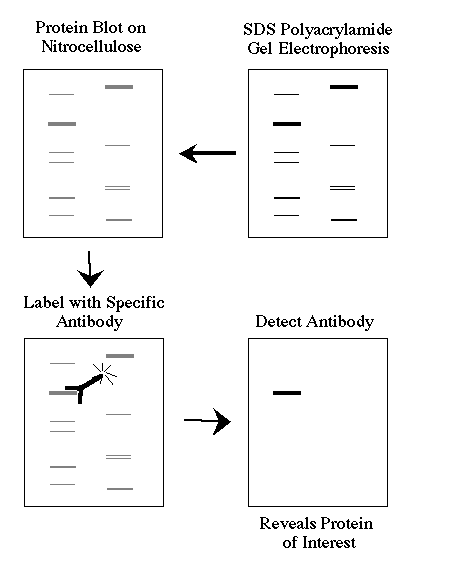
Western blots allow investigators to determine the molecular weight of a protein and to measure relative amounts of the protein present in different samples.
1) Proteins are separated by gel electrophoresis, usually SDS-PAGE.
2) The proteins are transfered to a sheet of special blotting paper called nitrocellulose, though other types of paper, or membranes, can be used. The proteins retain the same pattern of separation they had on the gel.
3) The blot is incubated with a generic protein (such as milk proteins) to bind to any remaining sticky places on the nitrocellulose. An antibody is then added to the solution which is able to bind to its specific protein. The antibody has an enzyme (e.g. alkaline phosphatase or horseradish peroxidase) or dye attached to it which cannot be seen at this time.
4) The location of the antibody is revealed by incubating it with a colorless substrate that the attached enzyme converts to a colored product that can be seen and photographed.
SDS-PAGE (PolyAcrylamide Gel Electrophoresis)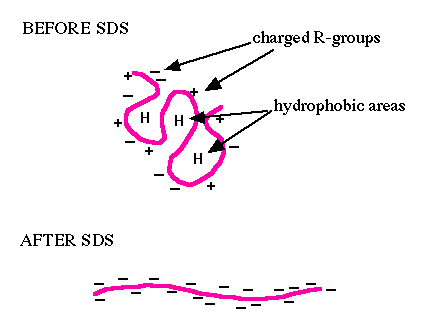
SDS (sodium dodecyl sulfate) is a detergent (soap) that can dissolve hydrophobic molecules but also has a negative charge (sulfATE) attached to it. Therefore, if a cell is incubated with SDS, the membranes will be dissolved, all the proteins will be soluablized by the detergent, plus all the proteins will be covered with many negative charges. So a protein that started out like the one shown in the top part of figure 1 will be converted into the one shown in the bottom part of figure 1. The end result has two important features: 1) all proteins retain only their primary structure and 2) all proteins have a large negative charge which means they will all migrate towards the positve pole when placed in an electric field.

No comments:
Post a Comment